October 2026 Newsletter Issue
Welcome to the Community Earth System Model (CESM) Newsletter. Want to receive our next newsletter in your inbox? Visit our newsletter page to subscribe and never miss a newsletter.
In this Newsletter:
Chief Scientist Message
Marika Holland named a MacArthur Fellow
Workshop Highlights
CESM Award Winners
CLM Tutorial Announcement
CMIP7 Hackathon
CESM Winter Working Group Dates
Public Lectures
Research Highlights from Our Community
Quick Links
Chief Scientist Message
|
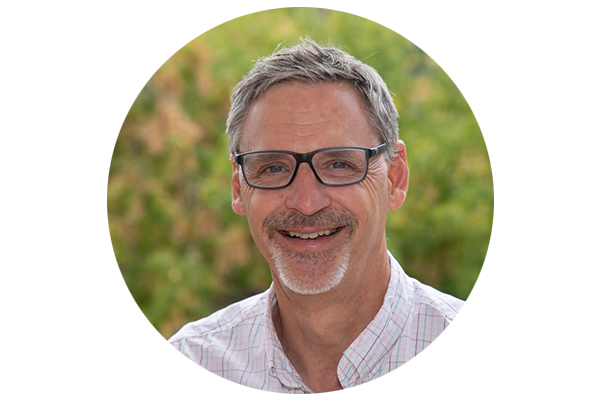
Welcome to the October 2026 Newsletter! I’d like to begin by extending huge congratulations to Marika Holland, former CESM Chief Scientist, on being named a MacArthur Fellow this week—an incredible and well-deserved honor that reflects her ongoing research applying CESM to understand and predict the rapidly changing polar climate system. Having known Marika since our graduate school days at the University of Colorado, I couldn’t be prouder. Congratulations are also in order for Kaiyu Guan from the University of Illinois, a valued member of the CESM community who was also honored with a MacArthur Fellow award. Kaiyu has long collaborated with the CLM group on agricultural research, most recently investigating the trade-offs and co-benefits of agrivoltaic systems. Additionally, we celebrate Charlie Koven, who received the annual CESM Distinguished Achievement Award, and Genevieve Clow, who earned the CESM Graduate Student Award.
Here at NSF NCAR, we are preparing to kick off the formal CESM3 Preindustrial Control run and are finalizing our updated MIP workflow. Huge thanks to our dedicated team of scientists and software engineers whose perseverance keeps driving us forward through every challenge. CESM3 will underpin community research for years to come, and we can’t wait to share it with you!
Read on for more details on these honors, upcoming tutorials, workshops, Winter Working Group meetings, public lectures, and research highlights from across the CESM community.
Marika Holland named a MacArthur Fellow
|
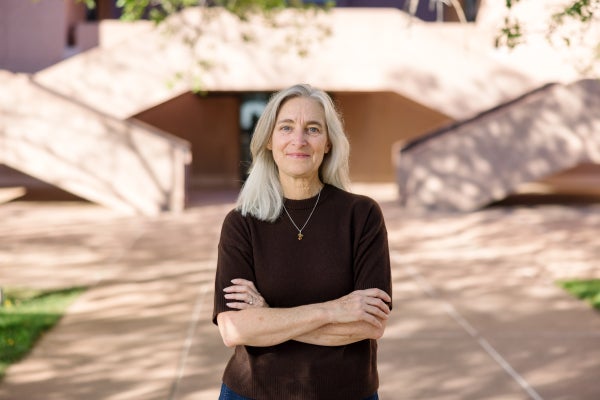
We are thrilled to share that former CESM Chief Scientist, Marika Holland, has been named a 2026 MacArthur Fellow! For those unfamiliar with this prestigious honor, it is awarded by the MacArthur Foundation in recognition of “extraordinarily creative individuals with a track record of excellence in a field of scholarship or area of practice, who demonstrate the ability to impact society in significant and beneficial ways through their pioneering work or the rigor of their contributions.”
Marika's research focuses on Earth's polar regions, especially sea ice: how it's changing, how predictable it is, and what that means for the global Earth system. She has also helped lead the development of the sea ice model used in CESM.
“Polar regions are changing incredibly rapidly, and there’s a great need to understand what those changes mean and what can be done to mitigate them,” Holland said. “We need the fundamental science to inform the answers to those questions, but it’s crucial that physical scientists like myself are able to build partnerships with biologists, social scientists, decisionmakers, affected communities, and others to ensure our work is as impactful as possible. I am excited about the opportunities this award gives me to continue building those connections.”
Congratulations, Marika!
Workshop Highlights
|
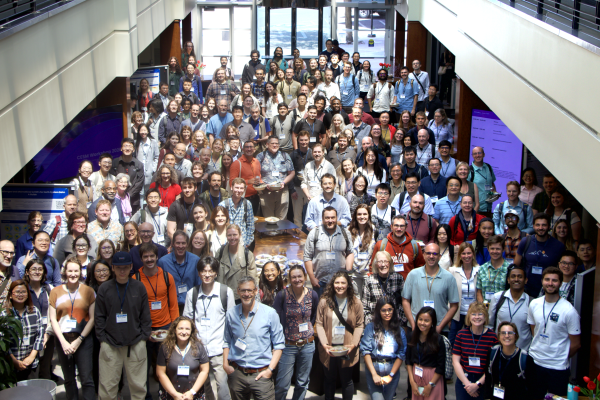
The 31st Annual CESM Workshop took place June 15–17, 2026. David Lawrence opened the meeting with the State of CESM address, followed by two awards: the CESM Distinguished Achievement Award to Charlie Koven and the CESM Graduate Student Award to Genevieve Clow. The program continued with plenary talks from Duncan Watson-Parris (Scripps/UCSD), James Done (MMM/NSF NCAR), and Gretchen Mullendore (MMM/NSF NCAR).
Missed a session, or want to revisit one? Presentation slides are available on the workshop agenda page, and the full recording is on YouTube. You can also browse the photo gallery and the poster gallery.
CESM Award Winners
|
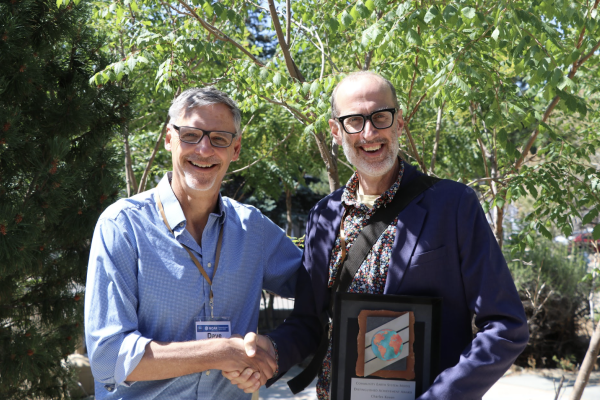
Charlie Koven - Lawrence Berkeley National Lab
Throughout his career, Charlie has combined his exceptional scientific creativity, intellectual breadth, and curiosity to make transformative contributions to CESM. From pioneering representations of permafrost carbon dynamics that helped distinguish CESM as a leader in coupled carbon-climate science to co-leading the development of the FATES, which is the next-generation vegetation ecosystem modeling framework that will form the basis of the next-generation CLM. Charlie has repeatedly reshaped how we present land processes in our system models. Beyond the scientific innovations, he has been a dedicated leader and community builder within CESM. He's now on the CESM Scientific Steering Committee, and he's influencing model developments, CMIP activities, and IPCC assessments. His work has really advanced both the scientific foundations and the future direction of CESM, making him an exceptionally deserving recipient of this recognition. See Charlie's presentation here.
|
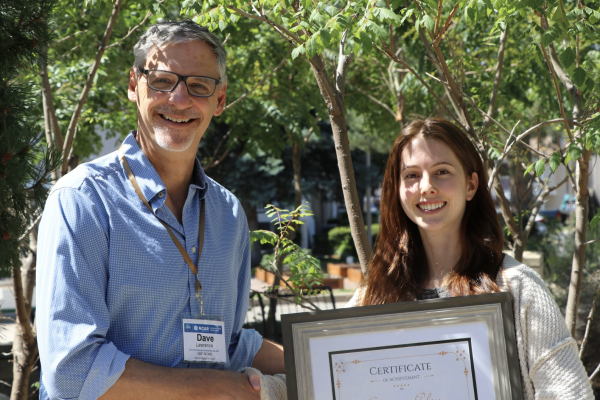
Genevieve Clow - University of Colorado
Genevieve's research has advanced our ability to compare CESM simulations with satellite observations of the ocean, addressing long-standing challenges in understanding how climate variability and change affect marine ecosystems. She developed a chlorophyll observing simulator package with CESM2, and developed innovative approaches to quantify satellite sampling biases and evaluate the detectability of extreme phytoplankton bloom events. Her work has strengthened CESM model evaluation capabilities and provided important insights into productivity and variability of the ocean. See Genevieve's presentation here.
CLM Tutorial Announcement
|
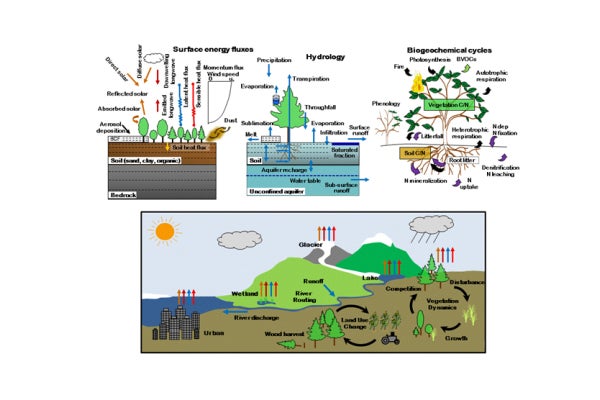
Announcing the 2026 Community Land Model (CLM) Tutorial happening November 16–19, 2026 at the NSF NCAR Mesa Lab in Boulder, CO. This will be a four-day introduction to the science and practice of using CLM as a research tool. Through lectures and hands-on practicals, participants will see how the model's science, underlying assumptions, and code structure fit together.
By the end of the tutorial, attendees will:
- Gain a foundational understanding of the science behind CLM and its features
- Be able to run and modify the model and work with its output
- Understand the high-performance computing (HPC) skills needed to use CLM
- Connect with peers and CLM scientists
- Learn in an inclusive, welcoming environment
With the upcoming releases of CESM3 and CLM6, this is a great time to get up to speed. We'll share the latest scientific capabilities and software features to support the research you want to do. The agenda will largely follow the structure of the summer CESM Tutorial, with a stronger focus on land. Sessions will cover the fundamentals of land modeling, and lab practicals will focus on model configuration, case customization, and data analysis. A substantial part of the week will be dedicated to new scientifically supported features in the model. If interested, please register here.
CMIP7 Hackathon
|
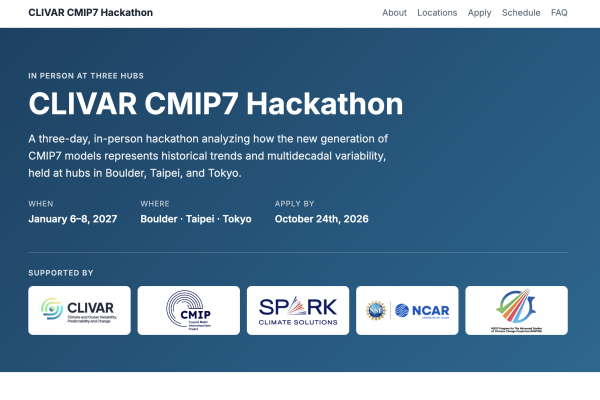
The CLIVAR CEMT-MV research foci are organizing a CMIP7 hackathon, to be held January 6th–8th, 2027. The primary node will be at NCAR's Mesa Lab in Boulder, Colorado, USA, with additional nodes at NTU in Taiwan and RCAST University of Tokyo in Japan.
The goal of the hackathon is to foster collaborations to examine the emerging CMIP7 simulations, with an aim to determine how well this next generation of models represents historical trends and multidecadal variability. Ultimately, the organizers hope to spur new research and focused publications in time to contribute to the IPCC AR7 assessment.
Thanks to generous contributions from SPARK Climate Solutions and the CMIP-IPO, limited resources are available to support some travel for early career scientists, and the organizers are continuing to pursue additional funding opportunities to maximize participation. For those planning to attend the AMS annual meeting, the Boulder node hackathon will take place at the end of the preceding week, making it convenient to attend both events.
More information and the application forms for each of the nodes can be found here. The hackathon is open to all, but early career researchers (within 10 years of PhD) will receive priority for any available travel support. Capacity at each node is limited. The application deadline is October 24th, 2026.
The organizing committee, including Isla, Tiffany, Ting, Yu, and others, encourages all interested researchers to apply.
CESM Winter Working Group Dates
|
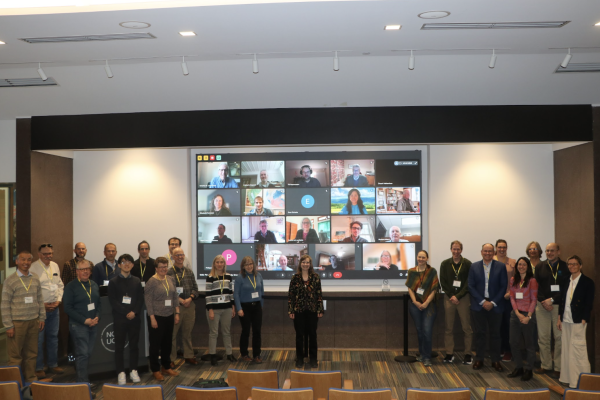
It's that time of year again! Please save the dates for the 2027 CESM Winter Working Group Meetings. These annual hybrid gatherings at the NSF NCAR Mesa Lab in Boulder, Colorado, bring together CESM scientists and developers to improve CESM's component models and coupling strategies. Participants present current research, discuss component updates, plan upcoming simulations, and work through software infrastructure challenges. Calls for presentations will be coming soon.
| February 1-4 |
AMWG, WAWG, CAWG, ESPWG, CVCWG (Atmosphere (incl. Whole Atmosphere and Chemistry/aerosols), Earth System Prediction, and Climate Variability and Change ) |
| February 9-11 | LMWG, BGCWG (Land and BGC) |
| February 24-26 | SEWG (Software Engineering) |
| March 8-9 | PCWG, LIWG (Polar climate and Land ice) |
| March 10-11 | OMWG (Ocean) |
| March 12 | PWG (Paleoclimate) |
Public Lectures

|
The Day After Tomorrow: Truth or fiction? - Gokhan Danabasoglu and Aixue Hu
In this Explorer Series lecture, researchers Gokhan Danabasoglu and Aixue Hu from NSF NCAR’s CGD Laboratory will explain what this major Atlantic Ocean current system, known as the Atlantic meridional overturning circulation, actually is and why we care about its behavior. They will then discuss what we know about its past and present changes, and what we can really say about its future behavior. Please watch here.
Modeling Earth’s Future: How models help us understand and shape decisions in a changing world - David Lawrence
David Lawrence will introduce the powerful computer models used to simulate Earth’s climate and explain how simulations with these models help inform decisions made by public and private stakeholders. The presentation will highlight how Earth System models help us understand the risks of global change and the effectiveness of mitigation strategies. This includes understanding how, where, and when forests and soils can or cannot be part of the solution. Join us for an accessible look at how modeling helps us better understand and shape Earth’s future. Please watch here.
Research Highlights from Our Community
An eastward-propagating coupled mode amplifying the early growth of extreme El Niño events
Yu Liang, Shang-Ping Xie, Alexey Fedorov, Qihua Peng, and Ayumu Miyamoto
Extreme El Niño events are among the most consequential climate phenomena, yet their early prediction remains challenging. Here, by analyzing the 1982/1983, 1997/1998, and 2015/2016 events together with a large ensemble of climate model simulations, we identify an unusually early and reproducible ocean-atmosphere precursor to extreme El Niño: a slow, eastward-propagating coupled mode that develops in the western-central equatorial Pacific during boreal winter and spring. This mode features warm sea surface temperature anomalies coupled with sustained westerly wind anomalies. These westerly wind anomalies drive the equatorward transport of warm water, rapidly increasing equatorial ocean heat content and priming extreme El Niño growth in the following summer and fall. Ensemble hindcasts further reveal that East Asian cold surges and the North Pacific Oscillation can stochastically excite this equatorial mode, enabling skillful forecasts of extreme events as early as February and helping to overcome the spring predictability barrier.
The 2026 western US snow drought was about four times more likely due to climate change
Adrienne M. Marshall, Marianne Cowherd, Stefan Rahimi, and Yuhong Ye
In the spring of 2026, anomalously low snow conditions in the western United States threatened winter recreation and water supplies. Here, we investigate: to what extent was this snow drought attributable to the climate change that has occurred since the pre-industrial period? We find that a snow drought this severe across the western United States was approximately 4.4 [95% CI: 2.6, 9.4] times more likely in the current climate than in the preindustrial period. In the Upper Colorado River Basin, the snow drought was approximately 14 times more likely [0.09, 4,300]. Given a projected increase in the frequency of snow droughts at least this severe in a moderately high emissions warming scenario, the lived experience of this event may help scientists, resource managers, and the public consider what western US snow might look like if greenhouse gas emissions are not aggressively reduced.
Dark Land Surfaces Allow for Refugia That Could Support Photosynthetic Life on the Surface of Snowball Earth
Greta E. M. Shum, Marysa M. Laguë, Abigail L. S. Swann, Cecilia M. Bitz, Edwin D. Waddington, Stephen G. Warren
Two “Snowball Earth” events occurred approximately 600 million years ago. During these events, the ocean was apparently covered with “sea glaciers”, hundreds of meters thick, which flowed like ice shelves. Yet, photosynthetic algae survived these events, indicating that small regions of liquid water (“refugia”) existed somewhere on the surface. Using a computer model of the Earth system, we show that even with a global average surface temperature below −60°C, some areas of the land surface reach above-freezing temperatures seasonally because they are darker than the ice-covered ocean. These above-freezing temperatures combined with local sources of water would allow photosynthetic life to survive.
The Impact of Enhanced Vertical Resolution on Seasonal Prediction Skill of the Quasi-Biennial Oscillation and Its Teleconnections in CESM2: A New Community Hindcast Dataset
Isla R. Simpson, Michael J. DeFlorio, Jiabao Wang, Nora R. Mascioli, Jim Edwards, Nan Rosenbloom, Matthew Simpson, Gokhan Danabasoglu, Yuanpu Li, Peter B. Gibson, Patrick Mulrooney, Stephen G. Yeager, Jadwiga H. Richter, Luca Delle Monache
A newly initialized prediction dataset with CESM2 is available and is described in this paper. These simulations were performed in collaboration with CW3E/ Scripps and consist of a suite of seasonal predictions with the low-top version of CESM2 and a version of CESM2 with enhanced vertical resolution and a raised model lid (close to the vertical resolution that CESM3 will have). The dataset can be found here and can be used to explore seasonal prediction skill in CESM2 and the impacts of enhanced vertical resolution.
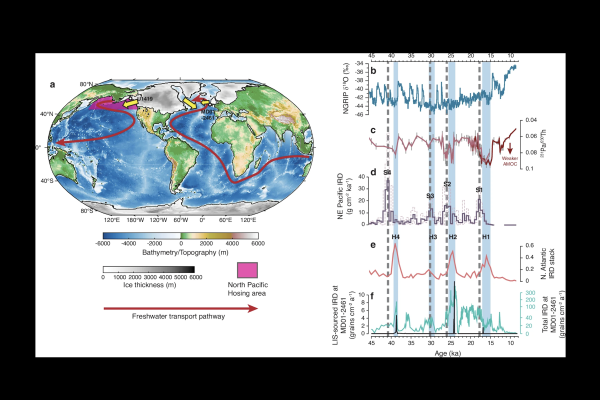
Caption
Fig. 1: AMOC strength and Greenland climate in relation to North Pacific and North Atlantic meltwater events over the past 45 thousand years. |
North Pacific meltwater weakens the Atlantic Meridional Overturning Circulation and preconditions Heinrich Stadial
Chijun Sun, Jiang Zhu, Bette L. Otto-Bliesner, Esther C. Brady & Sophia I. Macarewich
A new study led by UC Davis researcher Chijun Sun, and conducted in part through NSF NCAR’s Advanced Study Program in collaboration with NSF NCAR scientists, finds that iceberg discharge and meltwater entering the northeastern Pacific may have helped trigger a major weakening of the Atlantic Meridional Overturning Circulation (AMOC) during the last ice age. Using paleoclimate evidence and simulations on NSF NCAR’s Derecho supercomputer, Sun, Jiang Zhu, Bette Otto-Bliesner, Esther Brady, and Sophia Macarewich show that North Pacific freshwater input can weaken the AMOC and precondition Heinrich Stadial 1—a period marked by widespread Northern Hemisphere cooling and Antarctic warming. The result challenges the conventional view that North Atlantic iceberg discharge initiated these abrupt climate events, since such discharge appears to have occurred after AMOC weakening and Greenland cooling were already underway. The work, published in Nature Communications and supported by NSF and NSF NCAR, highlights the importance of interbasin ocean connections in abrupt climate change. See UCAR News and UCDavis News.
Climate benefit and ecological cost trade-offs for ocean iron fertilization
Jun Yu, J. Keith Moore, Francois W. Primeau, Anthony F. Michaels, Amy G. Nuno, Kristen M. Krumhardt, Michael N. Levy, Keith Lindsay, Hui Wang, James T. Randerson & Adam C. Martiny
A number of strategies have been put forward to help mitigate the rising levels of atmospheric carbon and so help combat climate change. One possibility is fertilizing the oceans with iron to stimulate the growth of marine algae, which can sequester carbon through photosynthesis, locking it away when the algae die and are carried into deeper waters. This strategy can have serious ecological side effects, such as rampant algal blooms, oxygen depletion, and nutrient depletion in adjacent regions, although the extent of these issues and any beneficial trade-offs are poorly understood. This article can be found on the cover of the 6 August 2026 nature issue.
Quick Links
CGD YouTube Channel
CGD Instagram
CGD LinkedIn
CGD Bluesky
CESM User Support Forum
CVCWG Simulations
Simpler Models Information
Thanks for reading this CESM Newsletter! Expect to see the next one in the Winter of 2027. Please send potential Newsletter items to Elizabeth Faircloth.