May 2026 Newsletter Issue
Welcome to the Community Earth System Model (CESM) Newsletter. Want to receive our next newsletter in your inbox? Visit our newsletter page to subscribe and never miss a newsletter.
In this Newsletter:
Chief Scientist Message
2026 CESM Workshop
New CESM Working Group Co-Chairs
2026 Crocodile Workshop
From Earth System Science to Sustainability: A TNC-NCAR Collaboration
Research Highlights from Our Community
Quick Links
Chief Scientist Message

|
Looking back on my message for the spring CESM Newsletter from last year, I have a sense of déjà vu. In that newsletter, I acknowledged the anxiety and sadness driven by the external pressures on science. And, I noted that despite this, we were continuing to work to produce a final configuration for CESM3. Well, the anxiety and sadness is ongoing, and we are still working on CESM3! As anticipated from past experience, we encountered and overcame many challenges as we finalized CESM3. But, we are now ‘done’ and are in the lengthy process of spinning the coupled model up. The 31st Annual CESM Workshop this summer will be an opportunity for us to share progress and (hopefully!) announce a CESM3 release date.
We are making good progress on other CESM initiatives as well, including the machine learning enhanced version of CESM (CESM3-MLe), a high resolution version, km-scale capabilities, interoperability with MPAS, the reintroduction of water isotopes and water tracking, regional versions of MOM6, along with lots of interesting and innovative new science. As always, we look forward to seeing our colleagues at the annual CESM Workshop, where we can catch up on all the great CESM-related science and development and form new projects and collaborations.
Summer is always a busy time at NCAR with lots of visitors, workshops, and the tutorial. Here are a few upcoming events:
- Hybrid Model Implementation Workshop, June 8-12
- CESM Tutorial, July 6-10
- S2S Land-Atmosphere Interactions Workshop, Aug 4-6
- Broadening Earth System Research Across Scales with High-Resolution Modeling Workshop, Sept 14-17
- Regional Ocean Modeling with MOM6 in the Community Earth System Model Framework, Sept 28-Oct 2
I’m looking forward to catching up with colleagues at one or more of these events.
2026 CESM Workshop
The 2026 CESM Workshop is right around the corner! We are excited to announce a Draft Agenda and our Plenary Speakers.
- Dates: June 15–17, 2026, in Boulder, CO.
- Registration Link
- Logistics (Links to book a hotel with special rates)
Plenary Speakers:

|
Duncan Watson-Parris, Scripps/UCSD - Gradients, benchmarks, and agents: a new toolkit for old uncertainties
Duncan Watson-Parris is an Assistant Professor at Scripps Institution of Oceanography and the Halıcıoğlu Data Science Institute, UC San Diego, where he leads the Climate Analytics Lab. His research focuses on aerosol–cloud interactions and their representation in global climate models, combining satellite observations, machine learning, and differentiable modelling to reduce uncertainty in anthropogenic forcing. He is a lead developer of JEM, the first fully differentiable Earth System Model, and leads the GAIA Initiative at UCSD. His research is supported by an NSF CAREER award, a Google Academic Research Award, and DARPA.

|
James Done, MMM/NSF NCAR - Advancing Climate Research to Provide Risk-Relevant Hazard Information
James Done leads the Weather Extremes Across Scales research section within NSF NCAR's Mesoscale and Microscale Meteorology Laboratory. He partners with risk managers to advance fundamental understanding of hazards in a changing climate while ensuring that new insights are usable in risk management decision-making. He currently serves on a National Academies Committee on Attribution of Extreme Weather and Climate Events and their Impacts. He is also a member of a US CLIVAR working group on Accelerating Research on the Scientific Foundations of Regional Climate Risk Information.
Cross-Working Group Sessions
On 14-15 June 2026, there are working group sessions designed to share information and encourage discussion and collaboration. We will have four cross-working group sessions this year:
I. Storytelling to craft climate science tools for communities: Explore how storytelling can make CESM data and experiments more engaging and relevant, helping connect research to community needs and inspire new insights.
II. Harnessing Machine Learning for CESM: Innovation and Integration: Highlight how machine learning is improving CESM, from parameterization to bias correction, while sharing progress, challenges, and future directions.
III. Earth System Prediction with CESM: Bridging Science and Real-World Applications: Focus on CESM-based prediction across timescales and its real-world value, with emphasis on practical applications and new tools to increase impact.
IV. Development and application of high-resolution CESM configurations: Examine advances and challenges in high-resolution CESM modeling, including regional and km-scale simulations across multiple timescales.
Registration opened on April 30, 2026, and will close for in-person participants on Friday, June 5, 2026.
Need more information? Check out our website.
New Working Group Co-Chairs and Scientific Steering Committee members
We welcome several new external CESM Working Group co-chairs and a new SSC member to the CESM leadership group.
- Ying Sun, Cornell University, LMWG
- Jung-Eun Lee, Brown University, PWG
- Pierre Gentine, Columbia University, SSC
We thank those who are rotating off, Rosie Fisher (LMWG), Ran Feng (PWG), Samantha Stevenson (PWG), and Sophie Nowicki (SSC), for their many contributions to the CESM activity. See here for the current list of CESM Working Group co-chairs and here for the current SSC membership.
2026 Regional Ocean Modeling with MOM6 in the Community Earth System Model Framework
Caption
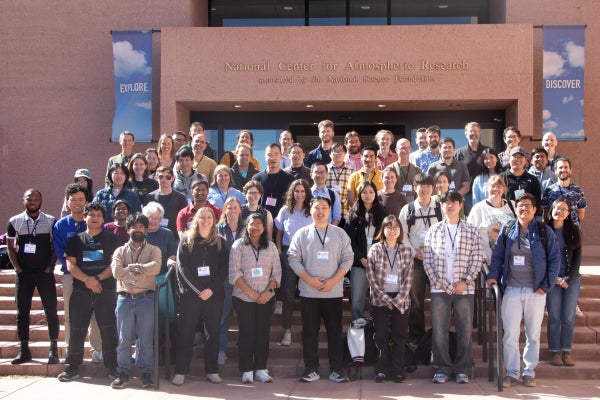
2025 Crocodile Workshop Participants |
Dates: Sep. 28 to Oct. 2, 2026
Location: NSF NCAR Mesa Laboratory Boulder, CO
We want YOU to be up and running a regional ocean model, with all the necessary forcing files, boundary conditions, etc., for arbitrary domains and model resolutions, including data assimilation capabilities, in a matter of hours rather than weeks or months! At NSF NCAR and WHOI, as part of the NSF-funded CROCODILE project, we are building Python and Jupyter notebook tools to configure new domains in MOM6 using the Community Earth System Model. Check out our documentation and demos here.
This is our second workshop to showcase capabilities, train new users, and develop collaborations. The first half of the week will guide participants through Jupyter-based tools for configuring and running regional MOM6 in CESM, including automated generation of the model grid and initial and boundary conditions. The latter two days will provide time for participants to develop their own custom domains and develop features in collaboration with the CROCODILE team. This year, we will highlight new capabilities for sea ice, data assimilation, and wave modeling. Last year's agenda can be found here.
The workshop will be held September 28- October 2, 2026, in person at the NSF NCAR Mesa Lab, Boulder, CO. The deadline to request travel support is July 7, 2026. We can accommodate up to 40 external participants. In the event of receiving additional applications, participants will be selected based on career stage and relevance to their interests and work. Participants from previous years are welcome to attend again to continue collaborating and learn about new tools. Note that new participants will be prioritized over those who have attended in previous years for travel support, and in the event of receiving more applications than available spots.
There is a registration fee of $175; a payment link will be sent to participants not receiving travel support in early September.
Please contact Elizabeth Faircloth, CESM Administrator, with any questions: fair@ucar.edu
From Earth System Science to Sustainability: A TNC-NCAR Collaboration

|
On April 22–23, 2026, twenty researchers and practitioners from The Nature Conservancy (TNC) joined twenty scientists from NCAR and UCAR UCP, including several from the CESM community, for a two-day workshop exploring how discoveries in Earth system science could inform solutions across the globe. Using a "World Café" style format, participants rotated through small-group conversations designed to find natural areas of overlap between our organizations. These breakouts sparked individual connections and research questions relevant to both TNC and NCAR. Workshop-wide discussions included the development of pilot studies, funding opportunities, and datasets. Group-wide discussions helped bring all ideas together into a broader picture of where Earth system science, especially including CESM and other NCAR modeling outputs, could inform decision-making and solutions, as well as how TNC knowledge could advance our Earth system models. As much as it was a scientific exchange, it was also a chance to build genuine relationships across the organizations. Workshop participants were energized by the connections made, and more than 25 potential research ideas and areas of collaboration were identified, along with concrete action items to keep the momentum going. If you have any questions or comments about the TNC-NCAR collaboration or you would like to get involved, please direct them to Rachel McCrary (rmccrary@ucar.edu).
Research Highlights from Our Community

|
Northern Hemisphere Wintertime Teleconnections from the 2023–24 El Niño Offset by Background SST Trends
Clara Deser, Stephen Yeager, Adam S. Phillips, Nan Rosenbloom, and Xueying Zhao
El Niño of 2023–24 ranked among the top five strongest El Niño events of the past 70 years, yet the expected wintertime atmospheric circulation and precipitation impacts over the Northern Hemisphere did not materialize. We investigate the reasons why this was the case and find that effects from long-term trends in tropical sea surface temperatures counteracted the expected El Niño teleconnections. Our results underscore the importance of considering the modulating influence of background sea surface temperatures on El Niño’s fingerprint, especially as anthropogenic climate change accelerates in the coming decades.

|
An Antarctic ecosystem value index to quantify ecological value across trophic levels and over time
Alice K. DuVivier, Kristen M. Krumhardt, Laura L. Landrum, Zephyr Sylvester, Bilgecan Şen, Sara Labrousse, Christian Che-Castaldo, Alice Eparvier, Marika M. Holland, Michelle A. LaRue, Cara Nissen, Michael N. Levy, Stephanie Jenouvrier & Cassandra Brooks
The Southern Ocean around Antarctica is one of the fastest-changing regions on the planet and an emerging resource frontier for fisheries. Here, we present the Antarctic Ecosystem Value Index created by merging ecosystem information across food web trophic levels, from phytoplankton to fish and penguins, to quantify the ecological value of marine areas around the Antarctic continent. We find that coastal polynyas - areas of reduced sea-ice - have Index values 31–72% higher than surrounding areas, suggesting that these areas are biologically valuable hot spots for a number of ice-dependent Antarctic Species. Using output from an Earth system model to generate future projections of the Index, we find that high-value locations, often within polynyas, are likely to continue to be valuable throughout the 21st century despite environmental changes. The Antarctic Ecosystem Value Index indicates that penguins lose importance as their habitat becomes increasingly unsuitable, so protecting high-value habitat areas may be critical for these species. This study also shows that while many high-value Index areas are within existing or proposed Marine Protected Areas, there are several opportunities for adopting additional protection, particularly in East Antarctica and the Amundsen Sea.

|
Reforestation scenarios shape global and regional temperature outcomes
Nora L. S. Fahrenbach, Steven J. De Hertog, Felix Jäger, Peter J. Lawrence & Robert C. Jnglin Wills
Large-scale reforestation is a prominent proposed climate mitigation strategy, but its full temperature impact remains poorly understood. Here, we present a systematic comparison of temperature responses to three distinct reforestation potentials using a fully-coupled Earth System Model. We find that reforestation consistently provides net global cooling, ranging from −0.13∘C to −0.25∘C, due to carbon uptake partially offset by biogeophysical warming. Crucially, a comparable net global cooling can be achieved with substantially smaller (450 Mha less area) but strategically located reforestation. Reforestation locally cools the tropics but causes albedo-driven warming in higher latitudes, which is often amplified by non-local effects. The different reforestation patterns alone can induce a wide range of non-local effects, showing that planting locations shape the biogeophysical response through atmospheric and oceanic feedbacks. Our findings underscore the importance of climate-smart policies that focus on the geographical placement of reforestation, considering both biogeochemical and biogeophysical effects to maximize cooling benefits.
Emergent climate change signals within Antarctic sea ice and associated ecosystems
Kristen M. Krumhardt, Laura Landrum, Bilgecan Şen, Alice K. DuVivier, Michael N. Levy, Cara Nissen, Marika M. Holland & Stéphanie Jenouvrier
Antarctic sea ice is projected to decline with continued global climate change, potentially impacting Antarctic ecosystems on several levels. Here, using a series of models, we show that substantial regional and seasonal differences exist in when and how climate change patterns manifest in Antarctic sea ice, phytoplankton, krill, fish, and penguins. Climate-driven changes in fish and penguins tend to emerge from historic variability earlier than sea ice and lower trophic levels. Changes are highly seasonal and can be either negative or positive; for example, krill growth increases in the spring, but decreases in the summer in many regions. The earliest climate signals emerge in Eastern Antarctic regions, while the Ross Sea remains a refuge from climate change into the twenty-first century. In the coming decades, summer sea ice loss in the Weddell Sea could improve the region for fish and krill growth, while remaining habitable for Emperor penguins.
Increased Model Resolution Amplifies Boreal Winter Arctic Precipitation and Atmospheric Circulation Response to Sea Ice Loss
Lantao Sun, Robert C. J. Wills, Clara Deser, Adam Herrington, Isla R. Simpson, and Melissa Gervais
This modeling study examines how increasing model horizontal resolution influences the atmospheric response to future Arctic sea ice loss. Using the Community Earth System Model, version 2.2 (CESM2.2), we conducted two sea ice loss experiments, one with a typical climate model resolution and one with very high resolution over the Arctic, following an experiment protocol similar to the Polar Amplification Model Intercomparison Project (PAMIP). The results show that higher resolution leads to greater increases in Arctic precipitation and its variability in response to sea ice loss. Additionally, the simulations with high resolution over the Arctic exhibit stronger lower-tropospheric temperature and circulation responses over the polar cap compared to the coarser-resolution simulations. These enhanced responses are likely linked to resolution-dependent differences in vertical motion. Our findings advance the understanding of high-resolution modeling and highlight the critical role of horizontal resolution in accurately simulating climate and climate change in the Arctic.
Balancing Backscatter and Diffusion in a 1/4° Forced Global Ocean Model
H. Yassin, G. Marques, I. Grooms
Ocean eddies move heat and nutrients around the globe and shape Earth's climate. Many global climate models now use a quarter-degree grid spacing, where ocean eddies are only partly resolved. At this resolution, older smoothing methods designed to mimic unrepresented eddies now remove too much energy and either eliminate the eddies or make them too weak. One proposed fix is backscatter, which returns some of that lost energy to the flow. We test backscatter in a global ocean–sea ice model and find that simply turning it on everywhere results in excessive heat transport toward the Southern Ocean. We then introduce a simple rule that determines where to smooth eddies and where to return energy, based on how large the eddies are relative to the grid. We test two ways of applying backscatter and find that the model is sensitive to where it is active. Energizing the Southern Ocean increases heat transport, whereas focusing backscatter on western boundary currents mainly strengthens those currents while leaving large-scale Southern Ocean patterns closer to the reference simulation. These findings emphasize the need to understand how backscatter affects heat transport in realistic global ocean models.
Quick Links
CGD YouTube Channel
CGD Instagram
CGD LinkedIn
CGD Bluesky
CESM User Support Forum
CVCWG Simulations
Simpler Models Information
Thanks for reading this CESM Newsletter! Expect to see the next one in the Fall of 2026. Please send potential Newsletter items to Elizabeth Faircloth.